



Giving charity in Islam is more than simply giving money to someone in need. It is an act of worship that reflects generosity, compassion, and concern for others. The Qur’an repeatedly encourages believers to spend from what Allah has provided, while the teachings of Prophet Muhammad ﷺ explain the value of sincere charitable giving.
Charity can take many forms, from financial assistance and providing food to supporting relatives, caring for orphans, and performing acts of kindness. Islam also places emphasis on why and how charity is given: sincerity matters, the dignity of the recipient should be protected, and charity should not be followed by reminders or hurtful words.
This guide explains what Islam says about giving charity, its importance, benefits and rewards, Qur’anic and Hadith guidance, appropriate recipients, ways to give, and special situations such as Ramadan and giving on behalf of someone else.
What Does Islam Say About Giving Charity?
Islam strongly encourages charitable giving and makes generosity an important part of Muslim life. Charity can be obligatory, as in Zakat when its conditions are met, or voluntary, often referred to as Sadaqah. Learn more about Sadaqah in Islam and its meaning, types, and benefits.
The basic principle is that Muslims should use what Allah has given them to do good and help others. The Qur’an describes those who spend in the cause of Allah with an example of a grain that produces seven ears, with one hundred grains in each ear, while stating that Allah multiplies the reward further for whom He wills.
Charity in Islam is therefore connected to both worship and social responsibility. It can help someone meet a genuine need while also cultivating generosity in the person who gives.
An important part of giving is intention. The Prophet ﷺ taught that spending on one’s family with the intention of seeking reward from Allah can itself be counted as charity.
This shows that charitable giving is not limited to handing money to strangers. Supporting people under your care and helping others sincerely can also carry spiritual value.
Why Is Giving Charity Important in Islam?
The importance of giving charity in Islam comes from its connection to faith, worship, compassion, and responsibility toward others.
Charity can:
- Help people meet essential needs.
- Strengthen bonds within families and communities.
- Encourage generosity instead of selfishness.
- Develop compassion for people facing hardship.
- Turn personal wealth into a means of doing good.
- Give the giver an opportunity to seek Allah’s pleasure.
Islam also teaches that charity should be given with respect for the person receiving it. Giving assistance should not become an opportunity to humiliate, embarrass, or repeatedly remind someone of what was given.
The Qur’an explicitly warns believers not to invalidate their charitable giving through reminders of generosity or hurtful behavior and also condemns giving merely to be seen by others.
The Role of Intention in Charity
The intention behind charity is central to Islamic practice. A person should give seeking Allah’s pleasure rather than praise, social status, or recognition.
This is especially important when a charitable act is visible to others. A public donation is not automatically wrong, but the giver should guard against showing off and should continue to focus on sincere worship.
What Are the Benefits and Rewards of Giving Charity in Islam?
The benefits of giving charity in Islam include both spiritual and practical dimensions. A person may help someone with an immediate need while also developing qualities such as generosity, empathy, and gratitude.
The Qur’an describes the reward for spending in Allah’s cause through the powerful image of a single grain producing many times its original amount, emphasizing that Allah can multiply the reward as He wills.
Spiritual Benefits of Charity
Giving charity can encourage a Muslim to:
- Become more generous.
- Think about the needs of others.
- Practice gratitude for Allah’s blessings.
- Develop compassion.
- Strengthen the habit of doing good.
- Focus on lasting spiritual values rather than material possessions.
The Qur’an also reminds believers that whatever good they spend for Allah’s sake will be fully repaid and that they should give seeking His pleasure.
Rewards for Giving Charity
Islamic texts describe significant rewards for sincere charitable acts. However, those rewards should always be understood in light of the Qur’an and authentic Sunnah rather than through popular claims circulated without reliable sources.
One important principle is that the reward is tied to sincere action. The Prophet ﷺ taught that spending on one’s family while seeking Allah’s reward can be counted as charity.
The Qur’an also teaches that charity should not be ruined by reminders, insults, or showing off.
What Does the Quran Say About Charity?
The Qur’an contains numerous teachings about spending wealth, helping others, sincerity, and the proper attitude toward charity.
Charity Can Bring Great Reward
In Surah Al-Baqarah 2:261, Allah compares spending in His cause to a grain that produces seven ears, each containing one hundred grains, while stating that He multiplies the reward further for whom He wills.
The verse emphasizes the extraordinary potential reward associated with sincere spending for Allah’s sake.
Give From What Is Good
Surah Al-Baqarah 2:267 teaches believers to spend from the good things they have earned rather than deliberately choosing inferior things that they themselves would not willingly accept.
The lesson is straightforward: charity should not be an excuse to dispose of things that are worthless or unacceptable while keeping the better things for oneself.
Charity Should Not Be Followed by Harm
The Qur’an warns against nullifying charitable acts through reminders of generosity or hurtful treatment of recipients. It also warns against giving for the sake of being seen by people.
This gives charity an ethical dimension. The way a person gives can matter just as much as the act of giving itself.
Private Giving Is Highly Praised
Surah Al-Baqarah 2:271 states that publicly disclosed charitable expenditures are good, but concealing charity and giving it to the poor is better.
This does not mean every public donation is forbidden. Rather, it highlights the special value of private giving when it better protects sincerity and the dignity of the recipient.
What Do Hadith Say About Giving Charity?
The Hadith provide additional guidance on the value, intention, and practice of charity.
The Prophet Muhammad ﷺ taught that spending on one’s family with the intention of receiving reward from Allah is considered charity.
Another important teaching concerns secret charity. In a well-known Hadith recorded in Sahih al-Bukhari, the Prophet ﷺ described among the seven people granted Allah’s shade on the Day when there will be no other shade a person who gives charity so secretly that his left hand does not know what his right hand has given.
The teaching illustrates the importance of sincerity and the virtue of giving without seeking public recognition.
Hadith About Giving Charity in Secret
Secret charity can help protect both the giver and the recipient from unnecessary attention. When people do not know what was given, the giver may be less likely to seek praise, while the recipient may feel less exposed or embarrassed.
The Qur’an likewise gives special praise to concealing charity and giving it to the poor.
How Much Should You Give to Charity in Islam?
There is no single universal percentage that applies to every form of voluntary charity.
The first distinction to understand is between Zakat and voluntary Sadaqah. Zakat is an obligatory form of charity with specific conditions and rules. Voluntary Sadaqah, by contrast, is broader and does not have one fixed amount that every person must give.
For voluntary charity, Muslims can give charity through money, food, water, practical assistance, and other beneficial acts. For a practical guide, see how to give Sadaqah in Islam.
The Qur’an identifies parents, relatives, orphans, the needy, and travelers among those who may be recipients of spending in a relevant passage on charitable expenditure.
The important principle is to give sincerely and responsibly rather than assuming that a person must follow one universal amount for all voluntary charity.
For detailed rules concerning Zakat, including its calculation, eligibility, and specific recipients, it is better to consult a dedicated and reliable Zakat resource or qualified scholar.
What Are the Ways to Give Charity in Islam?
Charity in Islam is not limited to one method. Muslims can give through financial assistance and through practical acts that genuinely benefit others.
Examples of Charity in Islam
Examples can include:
- Giving money to someone facing genuine hardship.
- Providing food to people who need it.
- Giving appropriate clothing or essential items.
- Supporting a struggling family.
- Helping an orphan or vulnerable child.
- Assisting a relative who is in need.
- Contributing to a useful community project.
- Supporting education or other beneficial causes.
- Providing practical help to someone who cannot manage a task alone.
A person can also turn ordinary responsibilities into acts of worship through sincere intention. As mentioned in Sahih al-Bukhari, spending on one’s family while seeking Allah’s reward can be considered charity.
The Prophet ﷺ also taught that charitable reward is not restricted to one narrow form of giving. Acts of genuine benefit and kindness have an important place within Islamic teachings.
Giving Charity in Secret vs. Publicly in Islam
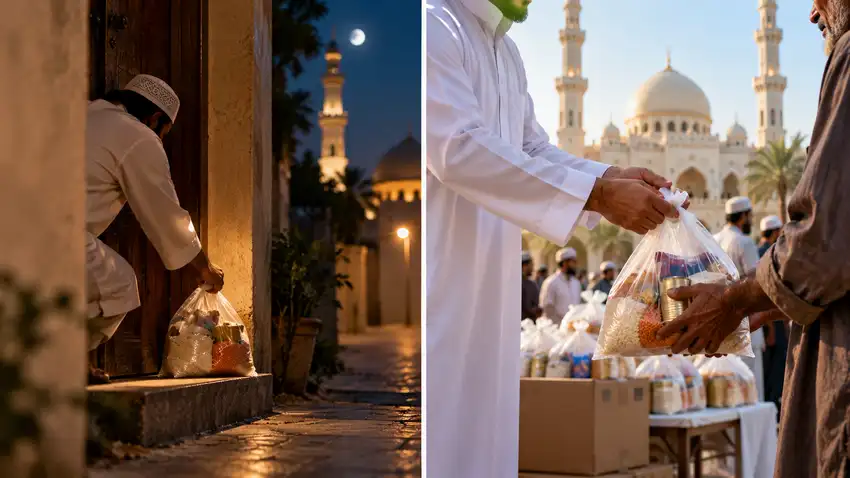
Both secret and public charitable giving can have a legitimate place in Islam, but intention is crucial.
Giving Charity in Secret
Secret charity is especially valued because it can help protect sincerity.
A person who gives privately may be less likely to seek admiration from others, and the recipient may be spared embarrassment. The Qur’an says that while openly disclosed charity is good, concealing charity and giving it to the poor is better.
The Prophet ﷺ also praised the person who gives charity so secretly that his left hand does not know what his right hand has given.
Giving Charity in Public
Public charity is not automatically sinful or invalid. In some situations, openly giving may encourage others to participate in beneficial causes.
The key issue is the intention and the manner in which the donation is made. A person should avoid turning charity into self-promotion or making recipients feel indebted or humiliated.
The Qur’an’s guidance makes the distinction clear: public giving can be good, while secret giving to the poor may be better in circumstances where it better preserves sincerity and dignity.
Who Can You Give Charity To in Islam?
Islam encourages helping people facing hardship, and the Qur’an explicitly mentions several groups in connection with charitable spending.
Surah Al-Baqarah 2:215 mentions parents, relatives, orphans, the needy, and travelers.
The exact rules concerning who may receive Zakat are more specific than the general concept of voluntary charity, so these two should not be treated as interchangeable.
Giving Charity to Family in Islam
Helping family members can be a meaningful form of charitable spending when it is done sincerely.
The Prophet ﷺ taught that spending on one’s family with the intention of seeking reward from Allah is counted as charity.
The Qur’an also mentions parents and relatives among recipients of charitable spending.
This means helping someone close to you who needs support should not automatically be viewed as less valuable than helping a stranger. In many circumstances, meeting the genuine needs of family can combine family responsibility, compassion, and worship.
Because financial responsibilities and Zakat rules can differ, however, charitable giving to relatives should not be confused with every form of obligatory financial support.
Giving Charity to Orphans in Islam
Orphans are specifically mentioned in the Qur’an among those for whom charitable spending can be directed.
Supporting an orphan can involve more than handing over money. Appropriate assistance may include food, clothing, education, housing-related support, or other legitimate needs.
Islamic charity should preserve the dignity and wellbeing of the child. The objective should be genuine care rather than publicity or making the recipient feel indebted.
Giving Charity During Ramadan
Ramadan is a particularly important time for worship, generosity, and community support. Many Muslims increase their charitable activities during this month by helping families, providing food, supporting community initiatives, and giving Sadaqah.
Charity during Ramadan should still follow the same fundamental principles that apply throughout the year:
- Give sincerely for Allah’s sake.
- Choose legitimate and beneficial causes.
- Protect the dignity of recipients.
- Avoid showing off.
- Give according to your circumstances.
- Do not neglect obligatory financial responsibilities.
Ramadan can be an opportunity to build a lasting habit of generosity rather than limiting charity to a single month.
Giving Charity in Someone’s Name in Islam
The phrase “giving charity in someone’s name” can refer to different practices, such as giving on behalf of another person or donating while intending the reward for someone else.
This topic needs careful treatment because Islamic rulings can differ depending on the exact situation—for example, whether the person is living or deceased and what kind of charitable act is being performed.
There is clear Hadith evidence that spending on other people can earn reward. For example, the Prophet ﷺ affirmed that a person would be rewarded for spending on the children of Abu Salama.
However, questions about dedicating the reward of a charitable act to another person, particularly someone who has died, involve detailed scholarly discussion. Anyone seeking a ruling for a specific circumstance should consult a qualified and trusted Islamic scholar rather than assuming that every situation has the same ruling.
Conclusion
Giving charity in Islam is both an act of worship and a practical expression of compassion. The Qur’an encourages Muslims to spend from what Allah has provided, promises multiplied reward for sincere giving, and teaches believers to give from what is good rather than what they themselves would reject.
The teachings of the Prophet Muhammad ﷺ further emphasize sincerity, including the special virtue of secret charity and the reward that can come from supporting one’s family with the right intention.
Whether charity is given during Ramadan, to a relative, to an orphan, privately, or through another beneficial form, the central principles remain the same: give sincerely for Allah, help people with genuine needs, protect their dignity, and follow reliable Islamic guidance.
Charity does not have to begin with a large donation. A sincere act of generosity, performed responsibly and for the sake of Allah, can be part of a Muslim’s ongoing commitment to doing good.