



The simple answer to what is Sadaqah is:
Sadaqah is a voluntary act of charity, kindness, or goodness that a Muslim performs to seek the pleasure of Allah and help others.
The word Sadaqah (صدقة) comes from the Arabic root related to truthfulness and sincerity. It represents a believer’s honest faith and willingness to do good without expecting anything from people in return.
According to the Sadaqah definition in Islam, it includes all voluntary acts of giving and kindness. Although many people associate Sadaqah with giving money to the poor, Islamic teachings describe it as a much wider concept.
Sadaqah can include:
- Giving money to someone in need
- Providing food to a hungry person
- Helping someone with a task
- Sharing useful knowledge
- Supporting a charitable cause
- Speaking kind words
- Showing compassion toward others
Therefore, the Sadaqah meaning in Islam is not limited to wealth. It represents a complete approach to generosity, mercy, and positive actions.
Sadaqah Meaning in Islam
The sadaqah meaning in Islam is connected with sincerity, charity, and good deeds. It shows that a believer recognizes their blessings and chooses to share them with others.
Sadaqah teaches Muslims that every act of kindness has value. A person does not need to be wealthy to give Sadaqah. Even a small action done with a sincere intention can become a valuable deed.
For example:
- Giving a glass of water to someone
- Helping an elderly person
- Comforting someone who is struggling
- Teaching useful knowledge
- Supporting a person in hardship
All of these actions can be considered forms of Sadaqah. Islam encourages Muslims to make generosity part of everyday life rather than limiting charity to special occasions.
Sadaqah in the Quran and Sunnah
The importance of Sadaqah is emphasized throughout Islamic teachings. The Quran encourages believers to spend from what Allah has provided and to support those who are in need. These teachings are part of the broader Islamic guidance on giving charity in Islam.
Sadaqah in the Quran
Allah says:
“The example of those who spend their wealth in the way of Allah is like a seed that grows seven spikes; in every spike is a hundred grains.”
(Quran 2:261)
This verse highlights the great reward associated with sincere charity.
The Quran also teaches believers to give without seeking praise from others. Charity should be based on sincerity and the desire to please Allah.
Sadaqah in Hadith
The Prophet Muhammad ﷺ encouraged Muslims to perform acts of kindness regularly.
A famous teaching states:
“Every good deed is charity.”
(Sahih al-Bukhari and Sahih Muslim)
This shows that Sadaqah is not only about money. Every beneficial action can become an act of charity.
Another teaching explains that even a smile can be considered a charitable act, showing the broad meaning of kindness in Islam.
What Does Sadaqah Include Besides Money?

Many people ask, “Does Sadaqah only mean giving money?”
The answer is no.
Islam defines Sadaqah in a much broader way. A person can give Sadaqah through wealth, actions, time, knowledge, and kindness.
Financial Sadaqah
Financial Sadaqah is the most commonly understood form of charity.
Examples include:
- Donating money to poor families
- Providing financial support to someone facing difficulties
- Helping with medical expenses
- Supporting Islamic or community projects
- Feeding people who are hungry
Even a small amount given sincerely can have great value.
Sadaqah Through Good Actions
Good actions are also forms of Sadaqah.
Examples include:
- Helping someone carry a heavy item
- Removing dangerous objects from a road
- Guiding someone who needs help
- Visiting a sick person
- Supporting a neighbor
These actions show that kindness itself is a form of charity.
Sadaqah Through Knowledge and Skills
Sharing beneficial knowledge is another important form of Sadaqah.
Examples:
- Teaching someone a useful skill
- Helping a student learn
- Sharing valuable information
- Advising someone positively
Knowledge that continues benefiting others can become a lasting reward.
Difference Between Sadaqah and Zakat
Many people confuse Sadaqah with Zakat because both involve charity. However, they have important differences.
| Sadaqah | Zakat |
| Voluntary charity | Obligatory charity |
| Can be given anytime | Usually calculated annually |
| No fixed amount | Has specific rules |
| Includes money and actions | Mainly related to wealth |
| Available to anyone who wants to give | Required for eligible Muslims |
Is Sadaqah Compulsory?
No, Sadaqah is not compulsory.
It is a voluntary act of worship. Muslims give Sadaqah according to their ability and intention.
Zakat, however, is one of the five pillars of Islam and becomes obligatory when a person meets certain financial conditions.
Both forms of charity encourage Muslims to support others and use their blessings responsibly.
Types of Sadaqah in Islam
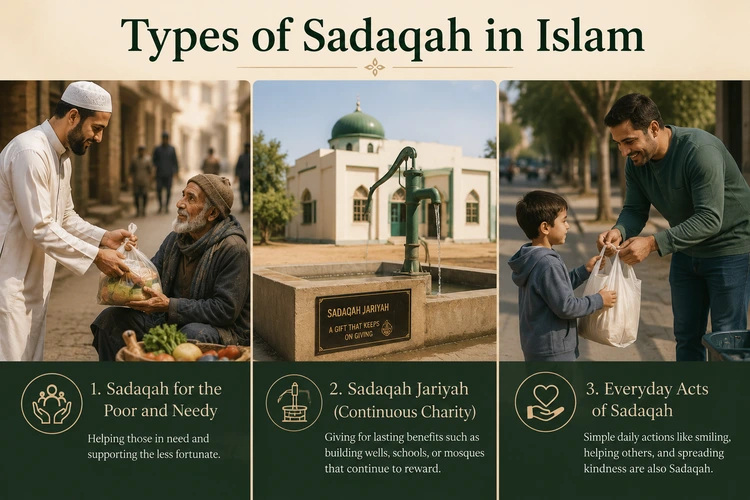
There are different types of Sadaqah that Muslims can practice.
1. Sadaqah for the Poor and Needy
Helping people facing hardship is one of the most common forms of Sadaqah.
This may include:
- Providing food
- Giving financial assistance
- Donating clothes
- Helping families in difficult situations
- Supporting vulnerable people
Islam encourages believers to care for those who are struggling.
2. Sadaqah Jariyah (Continuous Charity)
Sadaqah Jariyah means continuous charity. It is a good deed that continues benefiting people even after the person has given it. Sadaqah Jariyah can take many forms, including building a water well, supporting education projects, planting trees, creating useful resources, or supporting mosque construction. When a mosque continues to serve worshippers and the wider Muslim community, contributing to its construction can become a meaningful form of ongoing charity.
3. Everyday Acts of Sadaqah
Small daily actions can also become Sadaqah.
Examples:
- Smiling at someone
- Speaking politely
- Helping a stranger
- Showing kindness to animals
- Sharing beneficial advice
These simple actions show that Islam encourages continuous goodness.
Why Is Sadaqah Important in Islam?
Sadaqah is important because it benefits both individuals and society.
1. Sadaqah Strengthens Faith
Giving charity reminds Muslims that their wealth and blessings come from Allah.
It develops:
- Gratitude
- Humility
- Generosity
- Compassion
Sadaqah helps believers focus on helping others rather than only personal needs.
2. Sadaqah Helps Those in Need
Charity provides support to people facing challenges.
It can help with:
- Food shortages
- Financial difficulties
- Education needs
- Emergency situations
Through Sadaqah, communities become stronger and more supportive.
3. Sadaqah Creates Social Responsibility
Islam encourages believers to care for society.
Sadaqah builds:
- Stronger communities
- Better relationships
- Mutual support
- A culture of kindness
Benefits of Giving Sadaqah
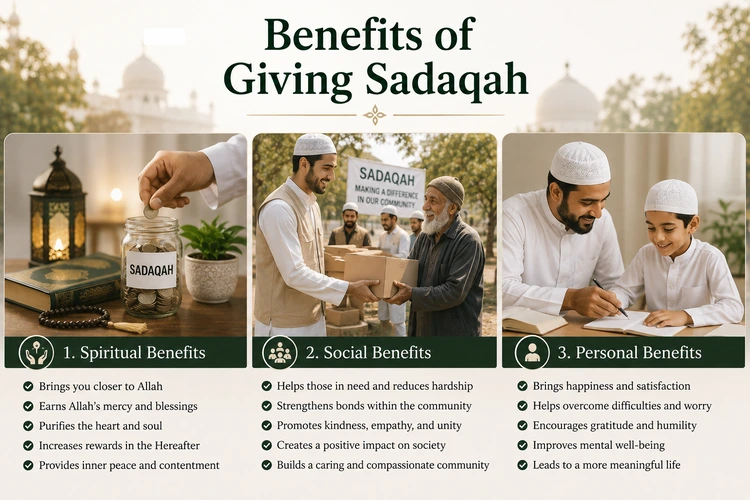
Giving Sadaqah brings many spiritual and social benefits.
Spiritual Benefits
Sadaqah can help a person:
- Increase faith
- Develop sincerity
- Seek Allah’s blessings
- Become more grateful
Muslims believe that sincere charity brings reward from Allah.
Social Benefits
Sadaqah helps:
- Reduce poverty
- Support vulnerable people
- Encourage cooperation
- Strengthen communities
Personal Benefits
Acts of kindness can also bring personal benefits:
- Greater happiness
- A stronger sense of purpose
- Improved relationships
- Emotional satisfaction
How Much Sadaqah Should a Muslim Give?
There is no fixed amount for Sadaqah.
A Muslim can give according to their ability.
The important factors are:
- Sincerity
- Good intention
- Willingness to help
A small amount given sincerely may be more valuable than a large amount given without genuine intention.
Islam encourages consistency, even if the action is small.
Best Time to Give Sadaqah
Sadaqah can be given at any time.
However, many Muslims choose to increase their charity during special times, such as:
- Ramadan
- Fridays (Jumu’ah)
- Times of hardship
- When someone needs urgent help
The most important thing is sincerity and the desire to help others.
Who Can Receive Sadaqah?
Sadaqah can be given to people who need support.
Common recipients include:
- Poor people
- Orphans
- Travelers facing difficulties
- Families experiencing hardship
- People affected by emergencies
A person should give charity respectfully and protect the dignity of the receiver.
How to Give Sadaqah in Islam?
Giving Sadaqah is simple.
1. Make a Sincere Intention (Niyyah)
The intention behind charity is important. Muslims give Sadaqah to seek Allah’s pleasure.
2. Give According to Your Ability
Every person can contribute something, whether large or small.
3. Give Without Expecting Praise
True charity is done sincerely, not for recognition.
4. Help People Respectfully
Charity should be given with kindness and compassion.
Examples of Sadaqah in Daily Life
Here are simple examples of Sadaqah:
- Feeding someone hungry
- Donating clothes
- Helping neighbors
- Supporting education
- Sharing knowledge
- Planting trees
- Helping animals
- Offering kind words
- Visiting someone who is sick
These actions show that Sadaqah is a daily practice of goodness.
Conclusion
Sadaqah is one of the most meaningful concepts in Islam. The meaning of Sadaqah in Islam goes far beyond financial charity. It represents generosity, compassion, sincerity, and every action that brings benefit to others.
Understanding what is Sadaqah in Islam helps Muslims recognize that even small acts of kindness can have great value. Whether through money, time, knowledge, or simple good deeds, every sincere act of Sadaqah reflects faith and a commitment to helping others.